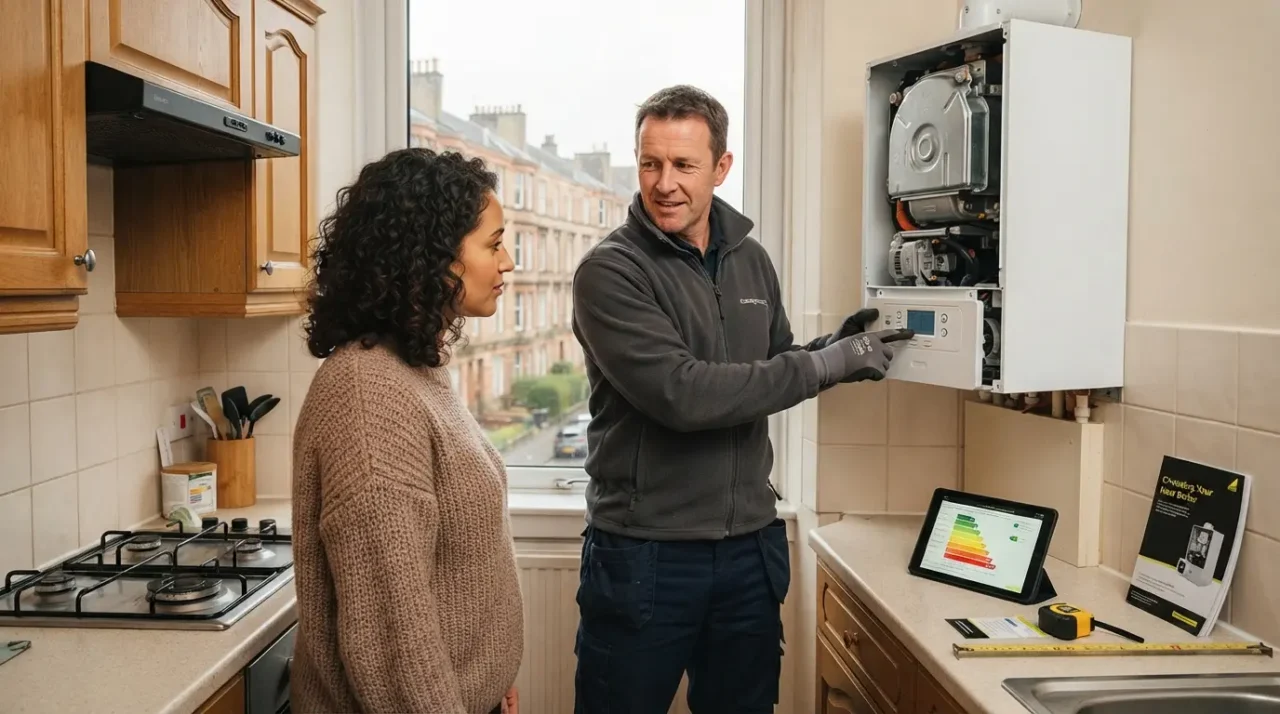
The right boiler for your home depends on your property size, hot water demand, and existing system. Most Glasgow homes use a combi boiler for convenience, while larger properties with multiple bathrooms often benefit from a system boiler with a hot water cylinder. Always get a Gas Safe registered engineer to size the boiler correctly rather than guessing based on your old one.
Choosing a new boiler isn’t something most homeowners do often, which is exactly why it feels harder than it should. Between boiler types, output sizes, and half a dozen brand names, it’s easy to end up either overpaying for capacity you don’t need or under-sizing a boiler that then struggles to keep up with your home.
This guide breaks down what actually matters when choosing a new boiler, so you can have a proper conversation with your engineer instead of just taking whatever’s quoted first.
Repair or Replace? Start Here
Before choosing a new boiler, it’s worth being honest about whether you need one at all. If your current boiler is under 10 years old and the fault is minor, a straightforward boiler repair is usually the better value option. But if your boiler is older, breaks down repeatedly, or the repair cost is creeping close to the price of a new unit, that’s usually the point where boiler replacement makes more financial sense than another patch fix. A good engineer will tell you honestly which category you’re in rather than pushing a new installation you don’t actually need yet.
The Three Main Boiler Types
Combi boilers are the most common choice across Glasgow, particularly in tenement flats and smaller homes. They heat water directly from the mains on demand, so there’s no need for a hot water cylinder or a cold water tank in the loft. That makes them compact and space efficient, though they can struggle slightly if two bathrooms need hot water at exactly the same time.
System boilers work well for homes with higher hot water demand, such as larger properties or homes with more than one bathroom. They use a hot water cylinder to store heated water, which means multiple taps can run hot water simultaneously without a drop in pressure, but they do need extra space for that cylinder.
Regular (conventional) boilers are typically found in older Glasgow properties that still have an existing cylinder and loft tank setup. They’re often the right choice when replacing an existing regular boiler like for like, avoiding the cost of converting the whole system to a different type.
If you’re unsure which category your home falls into, our heating engineer team can talk you through what your existing setup can support before you commit to anything.
Getting the Size Right
Boiler output is measured in kilowatts (kW), and getting this number right matters more than most homeowners realise. Too small, and the boiler will struggle to heat the property or provide enough hot water, especially in larger Glasgow homes or those with multiple bathrooms. Too large, and you’re simply paying more upfront and potentially running the boiler less efficiently than a correctly sized one would.
Sizing properly depends on the number of radiators, the number of bathrooms, the property’s insulation, and how many people are typically drawing hot water at once. This isn’t something to estimate from a chart online. It’s worth having a proper survey done, since the right size for a two bedroom tenement flat looks completely different to a five bedroom detached house.
Choosing a Boiler Brand
Different brands come with different strengths, and the right one often comes down to what’s already proven reliable in similar Glasgow homes. We regularly install and service Worcester Bosch, Vaillant, Baxi, and Ideal boilers across the city, and all four are well represented in both new installations and tenement conversions.
Worcester Bosch and Vaillant tend to be the two most common brands seen in newer Glasgow installations, both known for reliability and strong warranty terms. Baxi and Ideal appear more often in older systems, including some original tank fed setups still running in tenement flats, and remain solid, dependable options for straightforward replacements.
Whichever brand you choose, make sure the installing engineer is genuinely familiar with that manufacturer’s specific fault codes and parts. This matters more than it sounds, since fast, accurate diagnosis later on depends entirely on that familiarity.
What Else to Consider Alongside a New Boiler
A new boiler installation is often a good moment to review the rest of your heating system too. If your current thermostat is outdated, pairing the new boiler with a thermostat installation gives you far more control over heating schedules and can improve overall efficiency. If your home has consistently low hot water pressure, particularly common in upper floor tenement flats, an unvented cylinder installation alongside a system boiler can solve that properly rather than living with weak pressure indefinitely.
Understanding Boiler Installation Costs
Costs vary depending on boiler type, output size, brand, and whether any additional work is needed, such as moving the boiler’s location or upgrading pipework. Rather than comparing a single headline number between quotes, it’s worth checking exactly what’s included: the boiler itself, labour, any new parts like filters or thermostats, the warranty length, and whether a power flush is included to clear the existing system before the new boiler goes in. A transparent, fixed price quote given before work starts is the standard you should expect, not an estimate that changes once the job is underway.
Why Gas Safe Registration Matters
Every engineer who installs a boiler in the UK must be Gas Safe registered by law. This isn’t just a formality. It’s your legal protection and your guarantee that the person working on your gas appliances is properly qualified and checked. Always ask for the registration number and verify it on the official Gas Safe Register before any installation begins, and expect every genuine engineer to carry an ID card showing it without hesitation.